Petition Registers for The Caledonian Asylum
The Caledonian Asylum Petition Applications, 1819–1924
Tracing Scottish Families in London through Personal Testimonies, Family Records and Military Connections
The History of the Caledonian Asylum
The Highland Society of London launched an appeal in 1808 to raise funds for the establishment of an asylum to accommodate and educate impoverished Scottish children living in London. Many of these children came from families affected by the Napoleonic Wars (1803–1815), whose fathers had died, become disabled or were unable to support their families.
The appeal attracted support from prominent members of the aristocracy and military establishment, including the Dukes of Buccleuch, Queensberry, Gordon, Argyll, Montrose, Roxburghe, Wellington and Marlborough.
The Caledonian Asylum was established at Cross Street, Hatton Garden, London, to provide accommodation, education and opportunities for children whose families were experiencing hardship. The charity was formally incorporated in 1815 and subsequently expanded its work to support children from Scottish families living in London and elsewhere.
The surviving Petition Applications begin in December 1819 and form an important collection of personal testimonies, family information and supporting documents extending into the twentieth century.
The Three Application Forms
Application Description:
Form 1: For the child of indigent Scotch parents residing in London (not entitled to Parochial Relief)
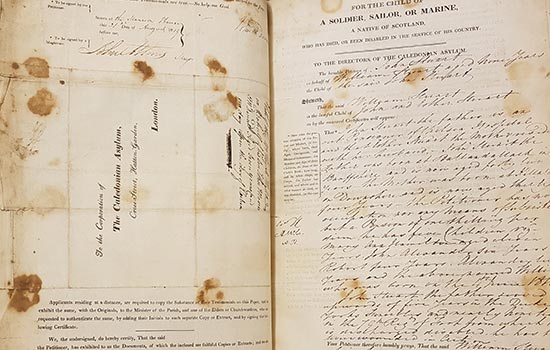
Form 2: For the child of a soldier, sailor/marine a native of Scotland who has died, or been disabled in service of his country
Form 3: Application for the Admission of Children into The Caledonian Asylum
Source: Petition Registers for the Caledonian Asylum, Cross Street, Hatton Garden, London. The London Archives (formerly London Metropolitan Archives), reference LMA/4710/C/02/01/001.
What Information Can Be Found in the Petitions?
The Caledonian Asylum Petition Applications contain an exceptional amount of personal and genealogical information concerning Scottish families living in London. All parents provided their own personal testimonials, explaining their family circumstances and the reasons for seeking admission for their children. These first-hand accounts are particularly valuable when researching families whose movements from Scotland have been difficult to trace.
| Category | Information recorded |
|---|---|
| Applicant’s personal information | Child’s name, date of birth, place of birth and age at application. |
| Parents’ details | Names, ages, dates and places of birth, occupations, marital status, and dates and places of marriage. |
| Family relationships | Names and ages of siblings, including children from previous marriages, and details of deceased family members. |
| Scottish ancestry | Scottish parishes of origin and information about grandparents, including their names, ages, occupations and places of residence. |
| Religious affiliation | Religious denomination of parents, church attendance, marriage details and supporting statements from parish ministers. |
| Personal testimonials | First-hand accounts provided by parents explaining family circumstances, financial hardship, bereavement, disability and reasons for seeking assistance. |
| Military and naval service | Rank, regiment, length of service, military or naval connections, and dates and places of death or discharge. |
| Sponsors and supporters | Names of subscribers, sponsors, witnesses and individuals who supported or recommended the application. |
| Medical information | Details of the child’s health, vaccinations, illnesses and examinations concerning infectious diseases. |
| Supporting documentation | Original baptismal entries, birth records, marriage entries and death certificates, together with handwritten copies or transcriptions where originals were unavailable. |
| Additional correspondence | Letters from parish ministers, character references, witness statements and correspondence relating to the family’s circumstances. |
| Admission information | Election dates, admission decisions and other administrative details concerning the child’s application. |
Not every application contains the same amount of information. The earlier petitions, particularly those dating from 1819 to the 1860s, frequently contain extensive personal testimonies and supporting documentation.
The Value of the Petitions to Scottish Genealogical Research
The Caledonian Asylum Petition Applications are an invaluable source for Scottish genealogical research, particularly when tracing families who left Scotland during the late eighteenth and nineteenth centuries. The personal testimonies provided by parents contain extensive information about their Scottish origins, family relationships, occupations, military service and the circumstances that led them to seek assistance for their children. Where entries in the Old Parish Registers are missing or cannot be located, these testimonies may provide the only surviving evidence of births, marriages and family connections. The petitions can help reconstruct family groups, trace migration between Scotland and London, and identify new avenues for research through supporting certificates, correspondence and witness statements. Their importance extends beyond genealogical information, preserving the personal experiences of Scottish families whose histories might otherwise have been lost.
The Research and Database Project
The Caledonian Asylum Petition Applications have been the subject of extensive research undertaken by Lorna Kinnaird of Dunedin Links Genealogy. Following many years of examining and imaging the original records at The London Archives, a database covering nine volumes of petitions has been compiled in collaboration with the Ontario Genealogical Society (OGS). The database provides an opportunity to identify Scottish families living in London through names, dates of birth, election dates and other genealogical information recorded in the applications. It also provides a starting point for further investigation into Scottish parish records, military and naval service, migration and family relationships. The project aims to make this important collection more accessible to genealogists and family historians, particularly those researching Scottish ancestors who disappeared from their parish of origin.
How to Access the Collection
1. The Original Petition Applications
The original petitions are held at The London Archives (formerly the London Metropolitan Archives).
Collection reference: LMA/4710/D
The London Archives – Catalogue Information
2. The Caledonian Asylum Petitions Database
The searchable database is available through the Scottish Special Interest Group of the Ontario Genealogical Society.
Caledonian Asylum Petitions Index, 1819–1924
A public index provides an introduction to the collection, while the complete members’ database contains more detailed information.
The Lothians Family History Society (LFHS) will have affiliate status with the Ontario Genealogical Society, allowing LFHS members access to the database through their annual society membership, currently £15. The Scottish Genealogical Society (SGS) is also considering affiliation with the OGS. Further information about membership and database access can be obtained directly from the Ontario Genealogical Society.

3. Obtaining Copies of Original Petitions
As part of my research, I hold images of the original Petition Applications and can provide copies for personal genealogical research. A small charge applies for supplying these images and donations to Forces Children Scotland will be made. Researchers wishing to obtain a copy of a petition can contact me directly through Dunedin Links Genealogy.
Copyright and Reproduction Restrictions
Copies of the original petitions are supplied strictly for personal research purposes. The images must not be uploaded to websites, online family trees, social media or other digital platforms, nor reproduced, published or shared with others without the appropriate permission.
Forces Children Scotland – The Continuing Legacy
The charity continues today as Forces Children Scotland, supporting children and young people from Regular, Reservist and Veteran families. Its work focuses on providing opportunities for children and young people to reach their potential through practical assistance, educational support, family services, advice and resources for schools and professionals. Although its work has developed considerably since the nineteenth century, its commitment to supporting children from Armed Forces families continues.
Visit Forces Children Scotland
Talks and Presentations
I am available to give talks on the Caledonian Asylum Petition Applications to Family History Societies, genealogical groups and other interested organisations. The presentation explores the history of the institution, the remarkable personal testimonies provided by parents, and the wealth of genealogical information contained within the petitions. Using case studies, I demonstrate how these records can help trace Scottish families who settled in London and uncover family connections that might otherwise have remained undiscovered.
For further information or to arrange a talk, please contact me through Dunedin Links Genealogy.
How can I help?
“Get in touch with your enquiry and I'll explain what I can do for you.”
Lorna Kinnaird